Union Arena - Sakamoto Days Analysis.

Updated: Jun 11
General Deck Appraisal Philosophy
Some decks are good at one thing in particular. Blue Kirito/Asuna Aincrad is excellent at multi-attacking via Double Attack and front-line-energy-line switches, and how Red Attack Titan excels at offensive power with Damage 2 and Impact 1 swings on large 5000BP characters. However, in recent times, meta-defining decks often have multiple strong aspects that allow them to cover a variety of defensive and offensive options. Red Kenshin, for example, is a deck that has early-game aggression, non-sideline removal, and is most notorious for disrupting energy lines by moving units into the energy line instead of sidelining them. Yellow Evangelion has tools to re-activate attackers, sideline frontline characters, gain Impact, and form a defensive wall of characters via Rei Ayanami [EVA-1-005].
The strongest decks in any set will typically have the following qualities, in order of importance/usefulness from top to bottom, left to right: Removal (Send to Removal Area, Bottom-Decking, Sidelining, Returning to Hand)
Play Units without Paying AP
Impact, Snipe, Damage 2, and Double Attack Keywords
Move a Character to Energy Line/Rest a Character in Front Line
Card Draw or Search X Abilities
5000BP+ (during both turns ideally)
Play Units in Active
4-Energy-and-Lower Playmakers
Other effects outside of this list shouldn’t be completely disregarded — anyone who has played Union Arena for a long enough time has likely been saved by a Negate Impact card on more than one occasion — but they tend to be niche or situationally useful. Keywords like Step and ±1000BP power modifiers are nice to have, but are seldom effects that warrant running a card over more impactful options.
If an exception to these general principles needs to be stated, it will be mentioned as-such in the deck breakdowns below. For instance, many decks that have a Special-Trigger Event Card that does not provide easy access to removal (ex. Yellow Exotic/Wardress, Blue Mayuri, Green Marleyan Warriors) find themselves lacking a critical tool to deal with opponents. Remember: Removal is the most important way to interact with your opponent's board state. That being said, Purple Shadow Army uses a Special-Trigger Event Card named Shadow Monarch [SLG-1-039] that instead plays out two rested characters or one active character. This combos well with other cards in the deck, making this card potentially play a 4000BP Igris [SLG-1-028] in Active with a 2500BP Shadow Soldiers [SLG-1-030] rested, ready to attack/block as needed, providing a higher degree of defensive and offensive pressure that 1AP usually affords.
With that, my analysis is as follows:
Sakamoto Days

Yellow Sakamoto
This deck is the clear stand-out from all the other decks in the set, and has almost everything going for it. It’s a Yellow deck, so it already starts with the best Color trigger in the game. The highest energy cost in a typical build will be 4 energy. It has access to Double Attack via Lu Shaotang; access to Impact 1 and Play for Free via Raid Sakamoto [SMD-1-026]; and what is one of, if not the best defensive raid ever released, Raid Sakamoto [SMD-1-025].
Playmakers:

Taro Sakamoto [SMD-1-026]
The flagship card from the set, this character’s When Played effect can help you play units for free from the top 5 cards of your deck, set them to Active, and even gains +1000BP and Impact 1 for the turn it’s played. The only downside to this card is that it will un-Raid itself at the end of your attack phase…
…A downside that’s more often than not a blessing in disguise. Raiding on top of the Color trigger Sakamoto [SMD-1-024] lets you put a blanket protection effect on any character not named Taro Sakamoto making them immune to targeting by all card effects. Raiding on top of the Step Sakamoto [SMT-1-023] leaves you with a decently-sized blocker that can Step back into your Energy Line if you need the energy. Even raiding on the Negate Impact Sakamoto [SMD-1-021] leaves a Negate Impact character to chump-block or negate Impact pressure from your opponent. This also happens at the end of your attack phase, so if you’re in a pinch and this card is Raided from Life, it can play itself out as a 5000BP blocker and play an additional character to block with, while still remaining as a viable 4000BP attacker for you to swing during your turn.
This card pulls a lot of weight in the deck. Anyone unfortunate enough to not see copies of this card will likely feel the deck precipitously losing power. But even if you can’t Raid into this Sakamoto? You know what’s the next-best, or possibly even-better-than-that Raid card you can use…?

Taro Sakamoto [SMD-1-025]
This defensive Raid card is nearly impossible to remove from the board when played. It has the option to target itself to give near-perfect immunity until the start of your turn. You can even apply its When Played protection to a Lu Shaotang [SMD-1-031] on your front line to protect a normally very vulnerable character from being targeted by anything, which includes triggers from life. The best part? This Sakamoto can’t be sidelined after it’s played, meaning you can block attacks with it and it doesn’t sideline after comparing BP, and since it has Negate Impact, you can even block massive 5000BP+ attackers and not even have the Impact keyword trigger due to losing a battle.
Removing this card is remarkably tricky when its protection is live, especially when it targets itself. Exotic solutions like Shigekuni Genryusai Yamamoto [BLC-1-092] defeating it in combat and then placing it in the Removal Area work or bouncing it to backline like with the [During Your Turn] effects on Kenshin Himura characters can help. If Sakamoto places its targeting protection on other cards, you can still target it with non-sidelining removal (Ryuutsuisen [RNK-1-100] and Burning Breath [ARK-1-030] for example). This is still a massively stubborn card to deal with, so you might just have to get used to it getting a free block the turn it’s played.

Lu Shaotang [SMD-1-031]
Lu Shaotang is the primary finisher for this deck. Being able to gain Double Attack every turn for the cost of six cards feels steep, but by late-game when this card is most effective, you’ll likely be pitching only one, maybe two cards to activate her effect. There is a benefit to adding other Sakamoto’s cards like Shin Asakura and the Sakamoto’s site card just to keep this cost as low as possible.
Do not forget that Lu Shaotang’s ability is a hard once-per-turn effect and is an Activate: Main effect (not When Attacking). Having two copies on the front line is not advised as a 2000BP attacker that generates two energy is likely better in the backline out of harm’s way until you need to swing with her on a following turn. As a brief aside, the site Sakamoto’s [SMD-1-035] helps bring this card into play active from hand at the cost of one additional discard, a useful effect, but one that should be prepared for in case your hand size gets lower than you’d like.

Purple Order Osaragi/Shishiba
This build of Order when played pure facilitates using the Action Draw mechanic in order to add additional, powerful effects to cards played afterwards. Your hand will always feel fuller than normal with this deck, and playing anywhere from 4AP to 5AP worth of cards on one turn is well within the realm of possibility. Characters in this deck are excellent attackers as well, with a shout-out to Takamura [SMD-1-056] being a character with additional Removal built-in that works best with the purest forms of this build.
Playmakers:
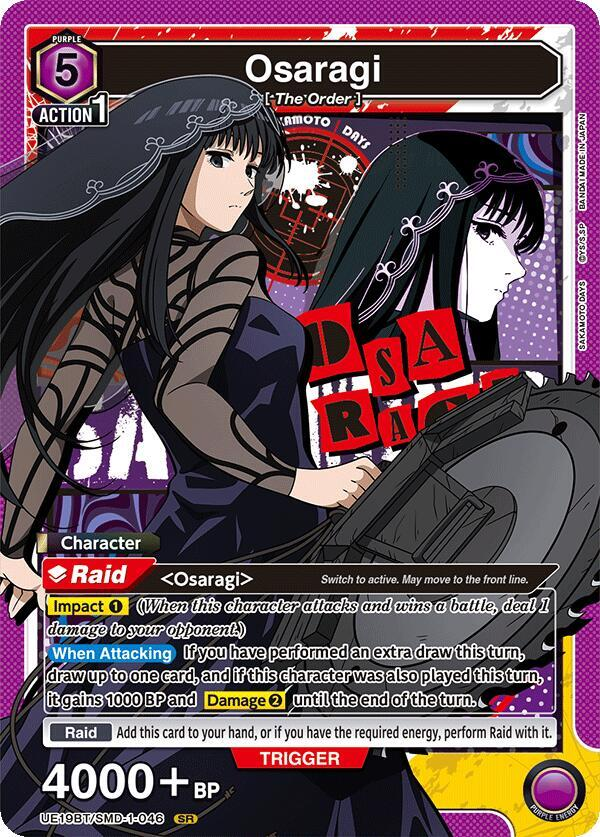
Osaragi [SMD-1-046]
This may be the most splashable card in the entire set, as every Purple deck will want this offensive powerhouse. Calling back to our Eren Jager (Attack Titan) [AOT-1-094] example at the top of the article, while Eren gets to keep his 5000BP stat line and has additional effects he can use to control the board, a lot of the time, he’s a 5000BP beatstick with the Impact 1 Damage 2 combination of keywords, and this is all for 8 energy which is a massive commitment to building up your energy line. Osaragi gets to this stat line with the same keywords for only 5 energy as well as drawing one additional card if you’ve Action Drawn earlier in the turn, which you will almost always have the leeway to set up. Even after her massive initial swing, a 4000BP Impact 1 character remaining for subsequent attack phases is often more than enough to slowly chip away at your opponent’s life. The only two downsides to this character is that it’s 5 energy, so you will have to establish at least one two-energy generator in your energy line before you play her. Second, is that Osaragi screams “Remove Me” at the top of its lungs, and any opponent who’s holding onto Removal will save it for removing this card specifically.

Shishiba [SMD-1-055]
There’s not much to say about this card. Shishiba will refund your Action Draw and the AP paid to play himself, promoting to a 4000BP attacker in your front line. Keep in mind, you can only use his AP re-activation effect as a hard once-per-turn. You could also use Nagumo [SMD-1-058] as a Raid target in the Nagumo/Sakamoto deck to get two AP back in the hybrid builds including him.

Purple Order Nagumo/Sakamoto
This deck is unique in that it is the only deck that interacts directly with the Triggers on a card outside of life. Get, Draw, Active, and even Raid can be activated during your main phase using this deck. Their Special Trigger Event card Master of Disguise [SMD-1-079] allows you to bottom-deck or even top-deck a card on frontline, providing the benefit of non-sideline removal. Placing a non-Raid card to the top of your opponent’s deck might also make their next draw dead, something to consider if your opponent finds themself in a chokepoint with too many of a specific character.
Playmakers:

Nagumo [SMD-1-061]
Nagumo has a very strange effect, allowing you to recur Raid characters from sideline, being especially useful when you use Nagumo [SMD-1-058] as this character’s bottom Raided card. This card feels like it’s more useful in Hybrid builds of Order as Nagumo can mix-in other Raids more effectively. Even if he’s left on the field as a 4000BP attacker, activating the purple Color trigger can set up a body on frontline to attack with or place a specific Raid target on the frontline to Raid over.

Taro Sakamoto [SMD-1-051]
This is a re-usable way to activate triggers so long as Sakamoto is on the frontline. The When Played to draw a card is good to see on a Raid, replenishing cards in hand without having to Action Draw. The one downside is the two energy or lower restriction on this card, meaning you can’t activate your Special triggers or Raids for free, but getting to use a free Draw or Active trigger every turn he’s on frontline is well worth it. A unique interaction with Nagumo [SMD-1-057] is targeting that card with an Active trigger and making your zero-energy Nagumo a 4000BP character with Impact. While I wouldn’t rely on that ability, it’ll catch some opponents off-guard if they assume your deck doesn’t have Impact natively in the deck. Taro Sakamoto [SMD-1-050] can also achieve this more easily using its When Played.
Purple Order Hybrids
The cards detailed in the Purple Order sections above will often mix well with one another. Adding in a Sakamoto [SMT-1-051] to an Osaragi/Shishiba build isn’t necessarily incorrect, nor does adding Osaragi [SMD-1-046] to a primarily Nagumo/Sakamoto build hurt. Mixing these Raids often adds utility and unpredictability to a strategy. These hybrid builds are where personal taste in deck composition shows through, and though it’s impossible to show all variants of these Order decks, one has been provided to show an example of splashing in Osaragi into Nagumo/Sakamoto for additional attack pressure. You’ll find Osaragi a very splash-able card in most any purple decks, even some Purple LABO decks appreciate having her as a tech card.
Yellow Shin/Heisuke
If you could see your opponent’s hand, your cards in life, or even the top card of your deck, wouldn’t that give you a strong edge in a match? This deck plays with making private information about your life area, top of your deck, and even in your opponent’s hand public. Knowing this, you can make better informed plays and avoid over-extending into removal or playing too conservatively. Ultimately, this is the biggest draw of the Shin/Heisuke deck, but make sure to capitalize on it before your opponent can make efforts to disrupt the advantage.

Shin Asakura [SMD-1-017]
This card acts as a utility piece to keep the rest of the deck running smoothly. If you already have the top of your deck revealed, he simply just draws you a card for free. However, if you need that set up, he can also turn the top card of your deck over. This effect is once per turn per copy of Shin Asakura [SMD-1-017], so if you have multiples of this card you’ll be able to quickly draw cards into your hand. The When Played effect to look at your opponent’s hand also assures you have perfect hand knowledge while functionally making your opponent’s next draw dead. This is a very solid card, but provides almost entirely utility for the deck’s other more powerful playmakers.

Heisuke Mashimo [SMD-1-008]
This card sets itself up in a way, and really only requires a face-up card in your deck to get its full offensive power. Snipe + Impact 1 feels like a staple in Union Arena for quality removal and unavoidable damage all in one. This card also scopes out one of your opponent’s life cards, letting you know if it’s a safe life card to target or if you should maybe choose another. It’s an interesting effect, but keeping Impact on this card can be a bit difficult without Heisuke Mashimo [SMD-1-006] on your field. The downside of this card is, while you do get to see what’s in your opponent’s life area, they also get to see yours, and attack accordingly to minimize disruptive triggers.

Shin Asakura [SMD-1-018]
This is the pay-off for having the top card of your deck face-up. If you do, this card plays active and draws you one card in addition to its rest and freeze effect. If you combine this card with a Shin Asakura [SMD-1-016], you can even play this card for 1AP, resulting in a super high-value play. This Shin is your secondary aggressor, able to stick down aggressive attackers or large 5000BP blockers. While not removing the card is a slight downside, if you target a Raided character with this ability, they’re likely not moving from that spot unless your opponent’s willing to push them out into the Removal Area. Or, you know, gets lucky and targets them with an Active trigger.

Yellow Hybrids
Just like in purple, you can mix in the yellow archetypes with one another. There is one card that loses out on this treatment: Lu Shaotang [SMD-1-031]. If you’re missing a critical mass of Sakamoto’s archetype cards, she’s going to be dumpstering your entire hand to gain her effect. Don’t get me wrong, Double Attack is a very good keyword, and if you can shoehorn her into a hybrid deck more power to you. But…
Don’t let this stop you from adding in Union Arena’s equivalent of crack cocaine, Taro Sakamoto [SMD-1-026], into a Shin/Heisuke deck.
This does make your ratios a little weird, especially when it comes to deciding what your Color trigger/ratio of both Color triggers for the deck is going to be. The juice is definitely worth the squeeze, however, as you do end up with a free-play unit that you can then attack with or Raid on top of to push your plays even further beyond. This deck is also augmented by Nagumo [SMD-1-012] who will allow you to Raid Sakamoto onto any other schmuck on the field, and this flexibility applies to Raid Sakamoto OR Raid Heisuke OR Raid Shin. There’s a lot of good going on in this deck, and recent tournament results can confirm this sentiment. This build combines the hand knowledge of Shin with the Snipe-Impact of Heisuke, combining three very powerful effects into a single deck. This deck will certainly have staying power in the meta, even more so than a purer build of Sakamoto’s, and I look forward to seeing what it’lll will do over the coming months.

Purple LABO
LABO feels like one of those decks where it’s likely the most interesting deck when it comes to play pattern and deck building, but suffers due to not having the highly desirable effects which make cards viable in a meta capacity. Still, they added two notable playmakers that punch way above the rest of the deck when it comes to their versatility. LABO is a deck that rewards timing — such as using Let The Fun Experiment Begin! [SMD–1-080] on a turn your opponent wants to move up from their backline — or using When Attacking effects to overwhelm the opponent — like when attacking through Natsuke Seba’s effect [SMD-1-068] to switch a spent attacker to active using Raid for free. The ability to slip underneath 4000BP+ blockers is a very useful effect too, but it ultimately means that chump blockers that were going to be used for blocking anyway are now going to block your stealthy cards.
Playmakers:

Invisibility Suit [SMD-1-071]
This card offers perfect effect protection and re-activation of When Player triggers, as well as retaining any When Attacking effects the cards underneath happen to have. This is an insanely powerful card, and it feels untowardly powerful in a deck like this. It unfortunately serves as this deck’s Color trigger — if it were a Get or Raid trigger it’d be even more useful. Use this card as often as you can when playing LABO. This card reminds me a lot of Rod Reiss (Titan) [AOT-1-038], a card in an otherwise lackluster deck that feels like it was made atypically strong relative to the other cards in its associated deck as a joke or something. Its 3500BP statline looks like it would hold it back as an attacker, but considering how Natsuke Seba [SMD-1-066] and Natsuke Seba [SMD-1-067] will both raise its attack to over 4000BP if used as a Raid target, it’ll still clear a lot of threats. Having baseline 3500BP is also good for blocking, as in a pinch if you have nothing but other 4000BP blockers, you can use this card to block with when your opponent tries to sneak attacks through that can’t be blocked by cards with 4000BP or more.

Natsuke Seba [SMD-1-069]
The ability to just damage your opponent’s life cards without attacking is powerful. Other cards that attack life cards without battle, such as Hiyuki Kagari [KGR-1-065] typically have the downside of damaging your life as well. Natsuke seems to have one too many restrictions on this effect to really be viable however. He needs to survive a while turn on your field, your opponent must have 3 or more life, and he even needs to be on frontline to use this ability in the first place. His built-in protection, similar to Reiner Braun [AOT-1-061], makes him a lot more capable ot surviving that additional turn. That being said, for anyone that’s played Reiner Braun, you know a lot of people are more than happy to pay that 1AP to remove a threat from the board, and that protection is useless when being targeted by Snipe on decks like Green GGO or Purple Shadow Army. This card feels like it’s going to scum wins off of certain opponents, but it’s far too boxed in to really shine.
Other Cards of Note

X [SMD-1-041]
I keep looking at this card and wanting to put it into Purple decks, but I can’t bring myself to do it. A baseline 5000BP blocker with Impact as well looks incredible, not to mention the longer X stays on the field the more value he’s going to provide. However, the 6 energy cost and lack of a trigger is really putting me off, as well as knowing he’d be taking the place of a similar card in Takamura [SMD-1-056] inside of Order decks. This card always felt like the 51st card in a deck, the one that just barely doesn’t make the cut. I’d like to mention this card, as it is technically a solid character, and feels like a more efficient Hisoka [HTR-1-107]. But just like Hisoka, it feels like a removal magnet at best and a liability at worst. I imagine opening two or more of these in your starting hand would make anyone reluctant to sleeve it up again.

Obiguro [SMD-1-001]
This feels like a solid, useful defensive option. You would more than likely add this into Shin/Heisuke deck, but if you have room in a Sakamoto’s deck and don’t mind this technically not being in-archetype, you can add it in for even more defense in your yellow deck. It’s even got an Active trigger on it. I didn’t include it in any of my decklists, but experimenting with this card in your own deck builds is worthwhile.

Intruder Elimination System [SMD-1-064]
I get that you want to play this card with the Invisibility Suit [SMD-1-071] Raid effect but… when is this situation going to come up?? I think this is by far the worst card in this set, as every single time I tried to make this happen, it just ended up languishing in my hand or in my energy line. If your opponent is ahead enough to have a full cadre of 4000BP aggressors, you don’t need Intruder Elimination System, you need Removal and a lot of it too. Try it out if you’d like, I bet it’s incredibly hype when it happens, but I simply cannot get this effect to work.
Final Assessment
The strongest deck in this set is Yellow Sakamoto. This will likely be a Tier 1 (or at least Tier 1.5) deck for the foreseeable future. There’s no shortage of offensive pressure this deck provides, but its defensive capabilities are truly noteworthy. Out-valuing this deck is likely the best way to win against it, but I’d hate to see how disturbingly efficient decks will have to become in order to completely outpace Sakamoto’s as a solid strategy.
The second-strongest deck(s) are Purple Order builds, notably those using Osaragi. I can say this deck will be roughly Tier 1.5, but likely towards the bottom of the top and can drop to Tier 2 with more powerful decks releasing in the future. I’d like to emphasize the customizability of this archetype, and depending how it’s both built and piloted, results with this deck will be very mixed. I’m interested to see where this deck will land after a few Regional equivalent tournaments where Order is allowed to be played.
I’d say in third place is Shin/Heisuke. When everything works in your favor, this deck will feel extremely oppressive through Sniping characters, reading your opponent’s hand like a book, and making your draws dead weight. This deck’s strongest aggressors need a bit of set-up however, and blundering a play where you could have flipped a card over in life or on the top of a deck will likely undo a bit of hard work you’ve put in. It’s just a smidge too slow to really push for clean, controlled victories, but I do like how we’re finally getting a deck that can see into your opponent’s life area and making targeting individual pieces of the life area matter.
The weakest deck in Sakamoto Days is LABO. In a high-variance game like Union Arena, don’t be shocked if you see this deck scum a win off of you however. This deck still has a capable strategy, and if you think it’s going to be an easy win like versus a Blue Mayuri or a Green Holy Brittanian Empire deck, this deck might just eat your lunch. Think your plays out unless you want Natsuke Seba to make a fool out of you. Being the worst deck in Sakamoto Days is kind of like saying you’re the dumbest student in an Advanced Placement class — it feels kind of disappointing, but you’re far, far from a remedial strategy.
Author - Degenerate
June 2026

Comments